Showing posts with label Nicholas Wells. Show all posts

Sunday, June 7, 2009

Germ Studies, live at Ausland in Berlin's Prenzlauer Berg


Germ Studies is an Australian duo made up of Chris Abrahams on a DX7 synthesizer and Berlin-based Clare Cooper on a zither-like instrument called a guzheng. I was fortunate enough to see them perform at Ausland in Berlin's Prenzlauer Berg on 4 June.

Opening is Organ-Off, whose more domineering half, Thomas Meadowcroft, overshadows his partner Magda Mayas. Through a series of seemingly planned false starts, their discordance is well measured, but nonetheless a sorry preview for the headliner.

Sitting audience-level following the opening duo's sprawl of six keyboards and synthesizers on stage, Germ Studies proceeded to play a number of pieces--some improvised, some taken from their newly released double CD, GERM STUDIES for guzheng & DX7.

Germ Studies' music is a conversation in time. The ages of the musicians, like that of their instruments, play into this recurring theme. Their eyes rarely meeting, they set to work extracting the most delicate noises as possible from their respective instruments. The result? Partly soundtrack to a digital planet, partly a study on the permanence of music.

While Abrahams' programmed synth carries the audience from thudding depths to painful and instantaneous highs, Cooper's guzheng morphs from ancient acoustic to space-age and back, played masterfully with fingers, palms, and drum sticks. Their mature and entirely accessible music resonates well with the German and American audience; given the experimental nature of the show, those gathered at Ausland are impressive in their knowledge and engagement.

Words: Nicholas Wells

Photo: Glenn O'Malley, from Clare Cooper's website.

Cool Tunes:

Germ Studies, Germ Studies for Guthberg and DX7, Splitrec, 2009.

Sunday, May 3, 2009

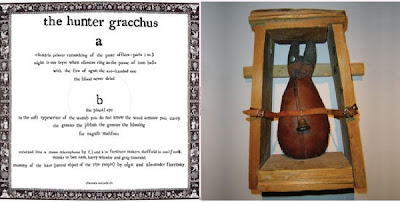
The Hunter Gracchus, Sacred Object of the Yiye People, Chironex Records


Sacred Object of the Yiye People, the debut LP from England’s The Hunter Gracchus, is a cacophony of improvisation, acoustic noise, and obscure literary and cultural references. The odd charm of the album emerges through an interplay between unconventional rhythm and hypnotic melody. Sacred Object's Bedouin influences stand out in a number of the tracks and make it traveling, richly textured, and entirely enthralling.

The album is constructed like a journey, with “elkadria priests’ ransacking of the PNAC offices—parts 1 to 3” and “for naguib mahfouz” neatly bookending the work as the departure and the arrival. In “night is our tryst when silences ring as the pause of bells,” sounds float in and out of earshot, finally culminating in a duet between accordion and drums filled with the drudgery of movement. The second half of side a, featuring “with the fire of ogun, the axe-handed one” and “the blood never dried”, is jarringly dissonant. Heavy-handed percussion overpowers the initially delicate tones, and we hear the only traditional instrumentation of the album: slightly distorted guitar riffs and the rhythm of a steam locomotive. 

Side b is more melodic, but not by much. Starting with “the pineal eye,” a sawing violin becomes an ambient metronome, and short gasps of accordion and percussion punctuate the melody. The drums are still there, but they become a melodic undertone, not like the pronounced rhythms of side a. Their musical influences are as much Bedouin street jams as contemporary noise and dream folk.

Some tracks open with the first notes of a carnivalesque accordion, only to become a repeated melody of four notes. These beginnings are like biting into a street hotdog: the bun feels artificial and misplaced, a barrier you have to get through to get to the meat inside. Once you’re in, the sound mirage is intoxicating and the improvisation becomes organic psychedelia.

After the initial opening, the listener must wait for rhythmic meditation to begin, and it’s not always evident in what direction a song is going. One exception to these misdirected openings is "naguib mahfouz,” the album’s closing track, in which ethereal voices, coupled with Hunter Gracchus’s signature heavy violin, create an interplay of surprising intensity. This is a song that I could be born / die / be buried to; it washes over you in layers and waves, evoking the water themes in The Hunter Gracchus, the Franz Kafka story from which the band takes its name.

Organically and acoustically, The Hunter Gracchus breaks musical sound into noises that don't seem to be coming from the instruments that produce them: a rhythmic clatter turns to stretched rubber; a squeak, combined with light rhythms, becomes the call of a caged chicken on a cinematic caravan of Bedouin traveling.

Many of their song titles contain clues to the band’s influences. These references range from populist political bravado ("elkadria priests’ ransacking of the PNAC offices” and  "the blood never dried" speak to the ex-subjects of the British Empire) to Arabic and Bedouin culture and literature (“with the fire of ogun, the axe-handed one” and “the greater the jibbah, the greater the blessing”). The cover art and album title are taken from artists Olga and Alexander Florensky's creation of a fictitious people, and of the ethnographer who studies them.

One problem with Sacred Object is that few of these references seem to lead anywhere; they add context but not dimension. Perhaps this is the lot of 21stcentury music: to draw connections where there are none, in deference to the dream of universal knowledge. While the disconnect between the alien music and abstruse literary and cultural references in the titles may make The Hunter Gracchus seem like a pretentious scenester band, their music is genuinely good.


Words: Nicholas Wells


Like what we're doing here? Just a little pocket change gives Visitation Rites food to live on.


Friday, May 1, 2009

The Reactable: “That was one of the goals: let’s allow everyone to have fun playing the instrument.”


If you have ever heard or seen the Reactable in action, it was probably during Bjork’s 2007 Volta tour. Largely influenced by the Moog synthesizers of the '60s and '70s, this new instrument is a translucent table with movable colored blocks that produces a range of rhythms, melodies, and sequences. If the Reactable has not received the mainstream recognition it warrants, this may be because it is not its tonal qualities that make it revolutionary for live performance, but its components. While its sound is unlikely to break the mold, the Reactable is a dramatic innovation in both interactive performance and music technology.


The instrument is the brainchild of four experimental musicians and music academics from Europe. I recently spoke with Sergi Jordà, Marcus Alonso, and Günter Geiger (the fourth, Martin Kaltenbrunner was in Austria and thus unavailable), who have been receiving awards for the invention on both sides of the Atlantic: Rolling Stone’s Hot Instrument of the Year, two D&AD Yellow Pencils, and the Golden Nica from Prix Ars Electronica.


The first aspect of the Reactable that sets it apart from other instruments is the simplicity of its interface, coupled with seemingly infinite outputs. Talking to its creators, I was reminded of the adage about the game Go: “a minute to learn, a lifetime to master.” Sergi said that the group wanted the Reactable to be simple enough so that new players would not become bored as they learned how to play, but open-ended enough so that progress would not render practice futile: “Being attractive and fun doesn’t mean that it’s simple.”


The other revolutionary aspect is the Reactable’s multi-user interface. Up to four performers can use the Reactable at once, creating a collaborative sound design unique to each particular performance. This collaborative element is manifest in the physical structure of the instrument itself: a "round table", designed so that no performer is the leader and all have an equal say in the music.


The technology behind (or, beneath) the Reactable is a vision-tracking software called reacTIVision, which allows the computer to keep track of multiple “tangibles” (the physical representatives of the virtual synthesizer’s modules) as well as finger touches on the table's surface. A camera beneath the table identifies and tracks the tangibles based on a symbol that distinguishes each module of the virtual synthesizer. In this way, tangibles can be placed on the table and introduced to one another, banding together and influencing one another’s output.


For example, when a Sequencer tangible is in place on the table, a waveform appears between it and the “output” at the center of the table. The tangible can be turned, like a knob, to change the frequency. A voltage-controlled filter (VCF) can be added to interrupt the Sequencer, appearing as an intermediary on the table. By rotating the VCF, the overtones of the sequence can be adjusted, creating more textured and interesting sounds.


The Reactable’s sound, as demonstrated in this Internet video, is generally drum-heavy synth beats; but its creators insist that while “you have to practice, it is possible to play a melody.” This distinction, however, is kind of a moot point: the Reactable was conceived of on a “higher level” of thinking involving “real-time interaction and performance.” 


There are disadvantages to the Reactable. Its limited mobility makes it difficult to carry along for a gig. But no one playing ordinary gigs will be using a Reactable anytime soon, as it has yet to become commercially available. There is a version out now in seven museums worldwide, but an industrial version should be available by the end of the year. Unlike the earlier Reactables, these newer instruments can be customized; while they will come with preprogrammed modules, the user can “add [their] own samples, sequences, layers of complexity.” The new version will include a “different interface for a configured table," harkening back to John Cage’s music for prepared pianos.


For someone with little to no knowledge of synthesizers or electronic music in general, the Reactable can be a welcoming introduction, presenting modules, frequencies, and waveforms in a simple, visual setting. For experienced musicians, it creates new realms of possibility for performance and collaboration.


Words: Nicholas Wells


Photos: Xavier Sivecas


Continuing Education:


The Official Reactable Website


Like what we're doing here? Just a little pocket change gives Visitation Rites food to live on.